
 August 14, 2026
For years, granite was the countertop.
If you were remodeling a kitchen in the 2000s or early 2010s, granite countertops were often considered the upgrade. Builders advertised them. Homebuyers looked for them. And kitchens everywhere featured polished granite with bold, busy patterns.
Then quartz exploded in popularity.
More recently, quartzite has become one of the most talked-about natural stones in kitchen design.
So homeowners are understandably asking:
Are granite countertops out of style?
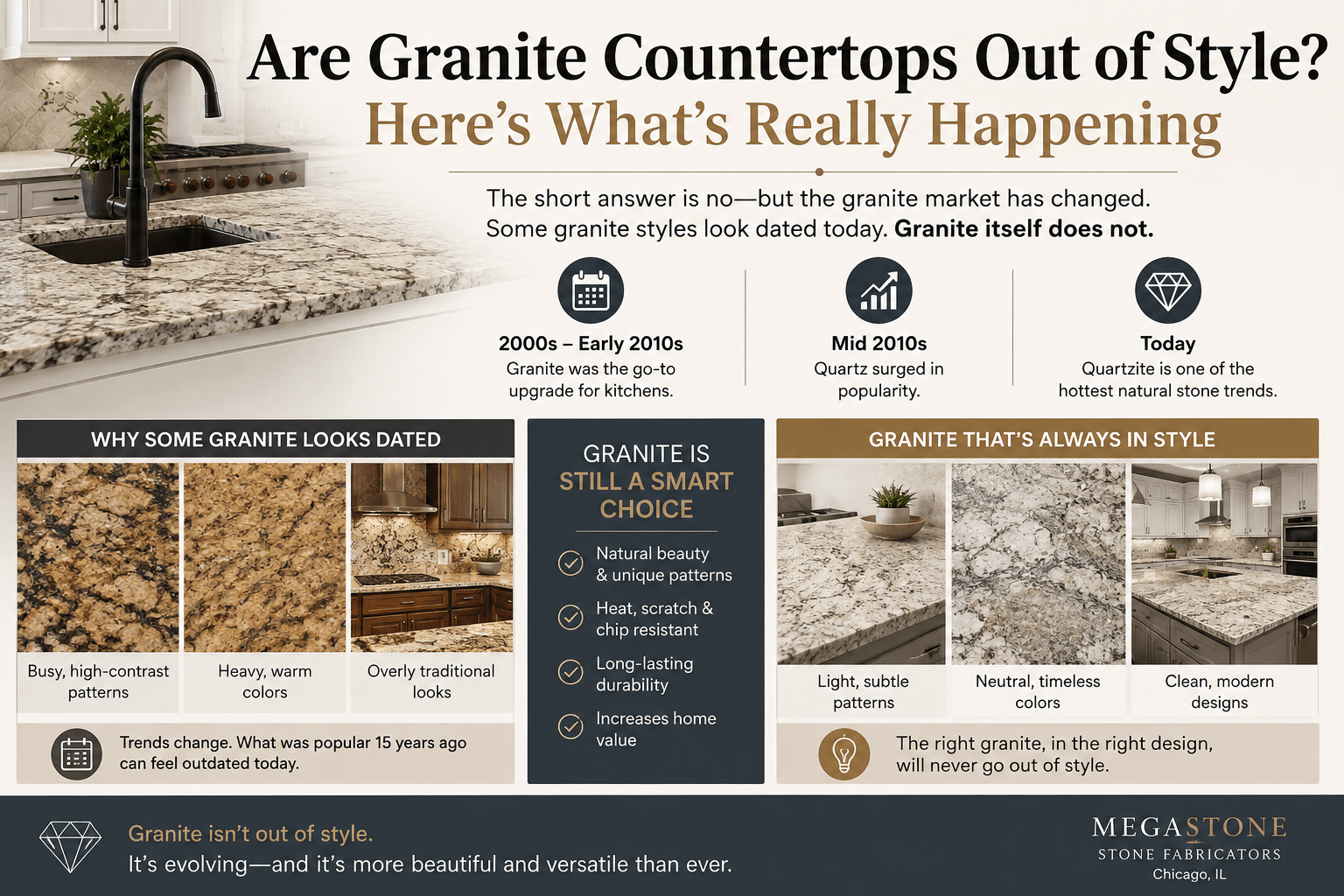
The short answer is no—but the granite market has changed.
Some granite styles absolutely look dated today. Granite itself does not.
And there’s an important difference between the two.
Granite didn’t suddenly become a bad countertop material.
The market changed around it.
Engineered quartz gave homeowners something granite couldn’t: greater control over color and pattern, a nonporous surface and very little maintenance.
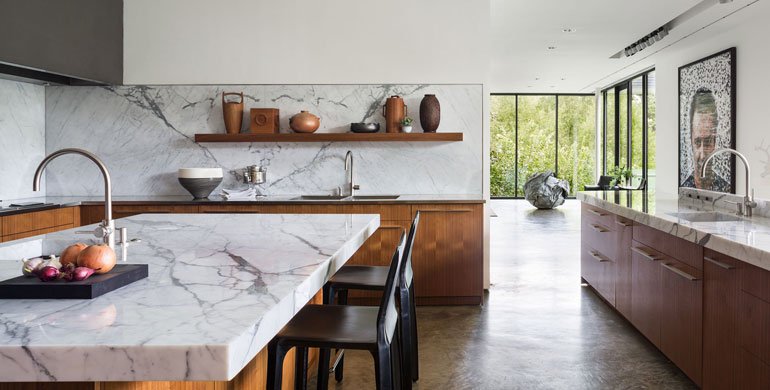
Then kitchen design moved heavily toward white countertops, subtle veining and marble-inspired patterns.
A lot of traditional granite simply didn’t fit that aesthetic.
The heavily patterned brown, gold, black and burgundy granites that were installed in millions of homes started becoming associated with an older generation of kitchen design.
That’s where the idea that “granite is outdated” really came from.
It wasn’t necessarily the material.
It was the look.
In a way, yes—but don’t expect the granite market to return exactly as it was 20 years ago.
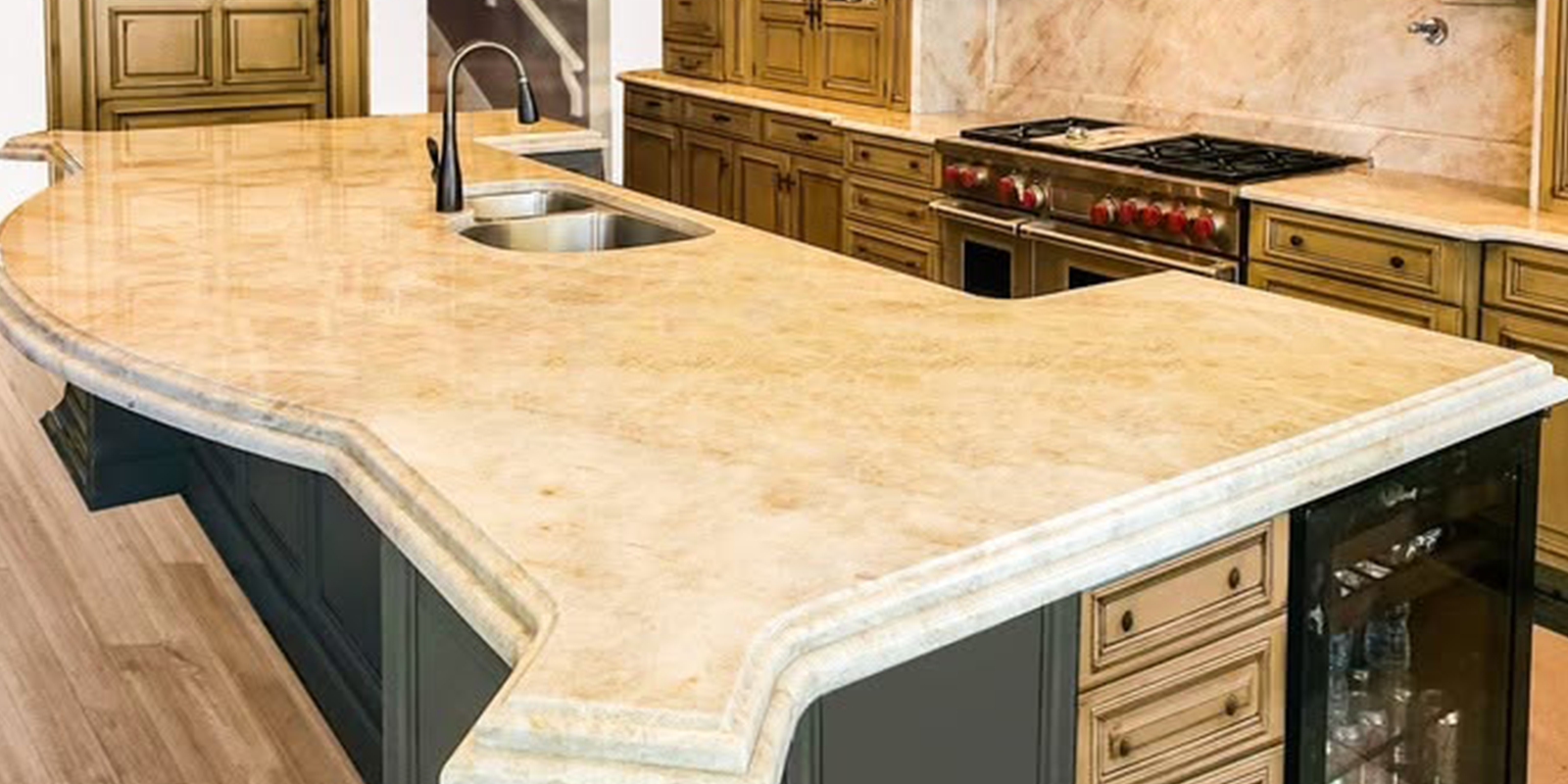
Today’s kitchen trends are moving toward natural materials, warmer colors, organic patterns and surfaces with character.
That’s actually good news for granite.
Homeowners spent years trying to make countertops look extremely clean and uniform.
Now we’re seeing more interest in materials that actually look natural.
Quartzite is benefiting heavily from this trend.
Granite can too.
But today’s customer may be looking for a very different granite than the customer of 2005.
Let’s be straightforward.
Some granite combinations immediately identify the era in which the kitchen was remodeled.
Think:
Very busy brown and gold granite + dark cherry cabinets + beige backsplash.
There was nothing inherently wrong with that combination.
It was simply used so extensively that it became strongly associated with a particular period of kitchen design.
The same thing can eventually happen to today’s countertop trends.
A material isn’t necessarily outdated.
A particular combination of color, pattern, cabinetry and backsplash can become outdated.
That’s an important distinction.
If you’re shopping for granite today, don’t assume every slab looks like the granite you remember from 20 years ago.
Natural stone selection is enormous.
Modern kitchens can use granite with:
Put the right granite with modern cabinets, hardware, flooring and backsplash, and it can look completely different from the traditional granite kitchen many homeowners picture.
Quartz solved several problems for consumers.
It’s engineered, so manufacturers can create predictable colors and patterns.
It’s nonporous.
It generally doesn’t require sealing.
And manufacturers became extremely good at producing marble- and natural-stone-inspired designs.
For homeowners who wanted a clean white kitchen with predictable veining and minimal maintenance, quartz became an easy choice.
But quartz has disadvantages too.
Because engineered quartz contains resin, high heat can damage the surface.
Quartz is also manufactured.
No matter how sophisticated the design becomes, homeowners who specifically want a slab created by nature may still prefer granite or quartzite.

Quartzite is probably the more interesting story in today’s natural-stone market.
Many quartzites provide exactly what current kitchen design is looking for:
Natural stone with flowing veins, warm colors and dramatic movement.
That’s why materials with the Taj Mahal-type aesthetic have become so desirable.
Quartzite can provide the visual elegance people associate with marble while generally offering better durability for kitchen use.
But there’s a catch.
Premium quartzite can get expensive.
Granite can sometimes provide an excellent natural-stone alternative at a more approachable price point, depending on the slabs being compared.
Granite didn’t stop being a good countertop because another material became trendy.
It remains one of the most proven kitchen countertop materials available.
This is one area where natural stone has a significant advantage over engineered quartz.
Granite doesn’t contain the resin binders used in quartz countertops and generally tolerates kitchen heat extremely well.
We still recommend protecting any countertop from extreme temperature changes, but granite is an excellent material for people who cook frequently.
A properly fabricated and installed granite countertop can last for decades.
It’s hard, scratch resistant and capable of handling the abuse of an everyday kitchen.
That doesn’t mean it’s indestructible.
Edges can chip. Stone can crack under certain conditions. And natural stone still needs proper care.
But granite has a very long real-world track record.
This is something engineered products simply cannot duplicate.
Every slab is different.
The crystals, colors, movement and mineral deposits were created naturally.
For some homeowners, that’s a disadvantage because they want consistency.
For others, that’s exactly the point.

Generally, yes.
Most granite countertops benefit from proper sealing, although porosity varies considerably between different stones.
Here’s where we think the maintenance issue sometimes gets exaggerated.
Sealing granite doesn’t necessarily mean you’re signing up for some enormous maintenance project.
A quality sealer and proper care can make granite relatively easy to live with.
But if your requirement is:
“I don’t want to think about sealing my countertops at all.”
Then quartz has a legitimate advantage.
We’d rather tell you that before you buy the stone.
Yes.
Natural stone can absorb liquids, particularly if it’s porous or inadequately sealed.
Oil is one of the substances homeowners should be careful with.
Wine, coffee and other spills should also be cleaned rather than left sitting on the countertop.
A sealer improves stain resistance.
It does not make stone magically stain-proof.
If someone tells you natural granite can never stain, that’s not a realistic expectation.
Sometimes.
And this is where granite can become very interesting.
Countertop pricing varies enormously depending on the specific slab, supplier, availability, thickness, fabrication requirements and project.
There are inexpensive and expensive granites.
There are inexpensive and very expensive quartz products.
There are also premium quartzites that can cost considerably more.
So don’t choose your material based on the assumption that quartz is always cheaper or granite is always more expensive.
Compare the actual materials you’re considering.
You may be surprised.
If you love a particular granite slab, don’t reject it because someone on social media told you granite is outdated.
Ask a better question:
Does this particular stone work with the kitchen I’m designing?
We would seriously consider granite for:
We’d probably steer you toward quartz if your biggest priorities are extremely consistent patterns, minimal maintenance and no periodic sealing.
And we’d show you quartzite if you want dramatic natural veining and are comfortable paying for and maintaining the right stone.
Granite isn’t outdated. Some granite looks are.
That’s the distinction homeowners need to understand.
The countertop market has become much bigger than it was 20 years ago.
Quartz offers consistency and convenience.
Quartzite offers dramatic natural beauty.
Porcelain and other surfaces are giving consumers even more choices.
And granite remains what it has always been:
A durable, heat-resistant natural stone capable of lasting for decades.
The difference is that today’s consumer has more alternatives.
And that’s a good thing.
Here’s something worth remembering when remodeling your kitchen:
Today’s trend can become tomorrow’s “dated kitchen.”
That happened to some granite designs.
It can happen to today’s quartz patterns too.
If you’re spending thousands of dollars on countertops, don’t choose something simply because Instagram says it’s popular this year.
Consider your cabinets.
Consider your flooring.
Consider your backsplash.
Consider how much you cook.
Consider maintenance.
And most importantly, choose something you’re actually going to enjoy looking at every morning.
At Megastone in Elk Grove Village, Illinois, we fabricate and install granite, quartz, quartzite and other countertop materials for homeowners, builders, contractors and designers throughout Chicagoland, Northwest Indiana, Milwaukee and southeastern Wisconsin.
We’re not interested in telling you that one countertop material is perfect for everyone.
We’d rather show you the differences and help you choose the material that makes sense for your kitchen, your budget and the way you actually live.
Granite isn’t dead. The countertop market simply grew up.