
 August 18, 2026
When homeowners ask us how to choose a countertop, one of the first questions is usually:
“What color should I get?”
White? Gray? Beige? Black? Something with gold veins?
But here’s the problem:
Color isn’t the first decision you should be making.
A countertop can look incredible as a full slab in a showroom and completely different after it’s cut into pieces and installed in your kitchen.
At Megastone, we’d rather start with your kitchen layout, how you use the space, viewing angles, slab dimensions, seams and vein direction.
Then we talk about color.
Because you’re not buying a slab to hang on a wall.
You’re cutting it apart and building a countertop out of it.
Before falling in love with a countertop design, look at your kitchen.
How large is the island?
Is it one piece?
Do you have an L-shaped countertop?
A U-shaped kitchen?
A waterfall edge?
A full-height backsplash?
Where is the sink?
Where is the cooktop?
Where will seams be required?
These questions can completely change which countertop works best.
A dramatic slab with large veins may look spectacular in a showroom.
But if your kitchen requires several pieces, those same veins have to transition from one piece to another.
Suddenly, layout becomes more important than color.
Most people choose countertops while standing directly in front of a slab.
That’s not how you’ll experience the countertop in your home.
Walk into your kitchen.
What’s the first countertop you see?
Can you see the island from the living room?
Do you enter looking toward the end of the island?
Can you see a seam from the main seating area?
Does a waterfall panel face the entrance?
What does the countertop look like from the dining room?
These sightlines matter.
A seam that is barely noticeable from one angle may be obvious from another.
A dramatic vein can look beautiful from the kitchen but strange when viewed from the adjoining room.
We don’t just think about how the countertop looks from above.
We think about how you’re going to see it every day.
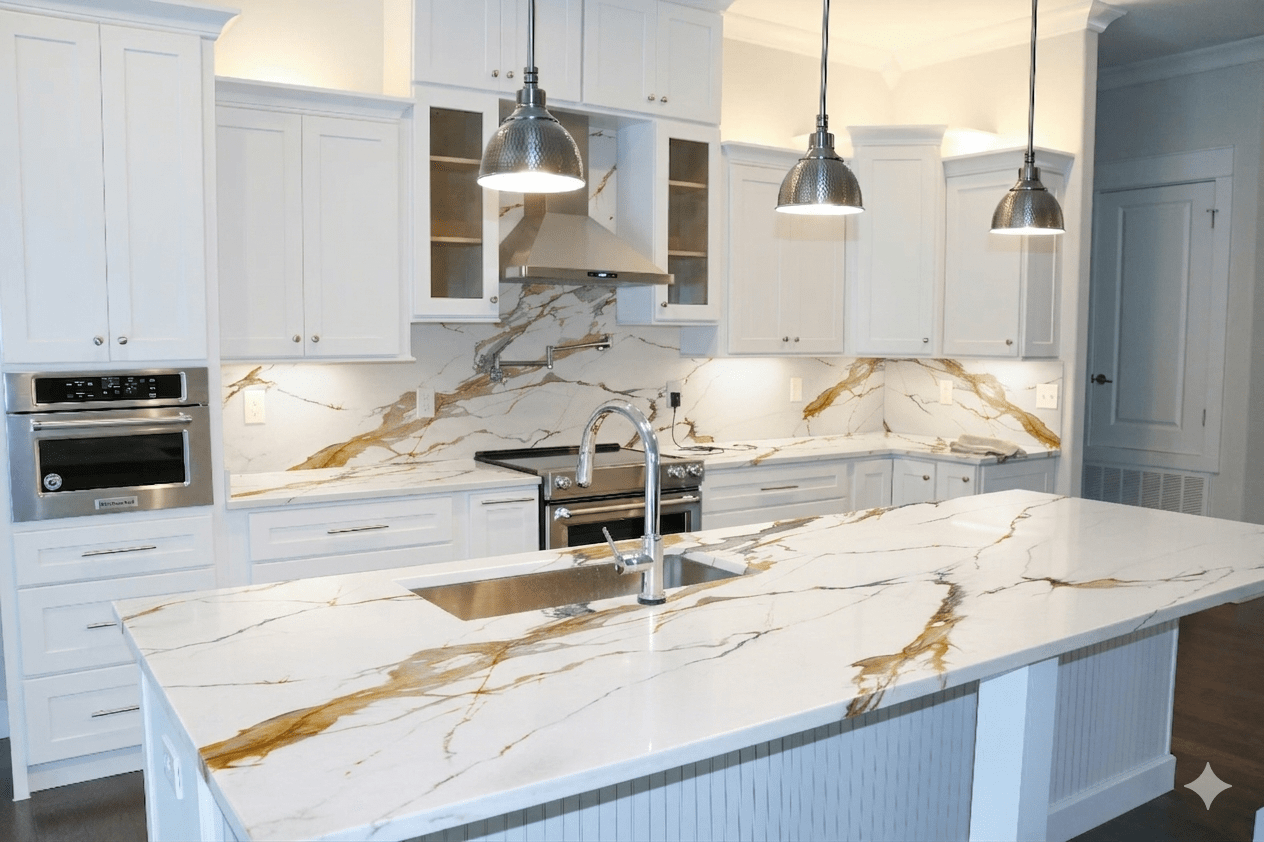
This is something homeowners often discover too late.
You find the perfect slab.
Then someone measures the island.
The slab isn’t large enough.
Now you have choices:
Add a seam.
Change the island.
Find a larger slab.
Or choose another material.
For a large kitchen island, slab dimensions should be checked early—especially if your goal is a seamless installation.
This becomes even more important with dramatic veining because a seam through a major vein can be much more noticeable than a seam in a subtle pattern.
Before falling in love with a countertop, ask:
Can this material actually accomplish the layout I want?
Every customer wants invisible seams.
Here’s the reality:
A seam is a seam.
Good fabrication and installation can make seams clean and minimize their appearance, but two separate pieces of countertop don’t magically become one slab.
Where the seam goes matters.
With subtle or relatively uniform countertops, seams can often blend more easily.
With heavily veined materials, seam placement becomes much more important.
Imagine a large vein traveling across your countertop and suddenly stopping at a seam.
Then another vein starts in a completely different direction.
Your countertop may still be perfectly fabricated.
But visually?
It may not be what you expected.
That’s why seam planning needs to happen before fabrication—not after installation.
Today’s countertop market is full of dramatic veining.
And that’s where planning becomes especially important.
Consider an L-shaped kitchen.
If the veins run one direction on the first countertop, what happens when the countertop turns 90 degrees?
Should the veins turn?
Should they continue?
Can they even continue based on the slab?
Now add an island.
Should the island veins run toward the range?
Toward the sink?
Along the length of the island?
Toward the main entrance?
There isn’t one correct answer.
But there absolutely can be a bad answer.
Vein direction should make sense within the room.
This is especially important with natural stone.
Customers sometimes see a beautiful continuous vein in a rendering and assume the finished countertop will look exactly like that.
Reality is more complicated.
Every cut removes material because the saw blade itself has thickness.
Edges may require additional fabrication.
Pieces may need to come from different areas of the slab.
Your kitchen may require more than one slab.
And natural stone doesn’t repeat its pattern.
A skilled fabricator can carefully plan cuts to improve vein flow and seam transitions, but perfect vein matching isn’t always physically possible.
The goal should be a thoughtful, visually balanced layout—not an unrealistic expectation that every vein will connect perfectly.
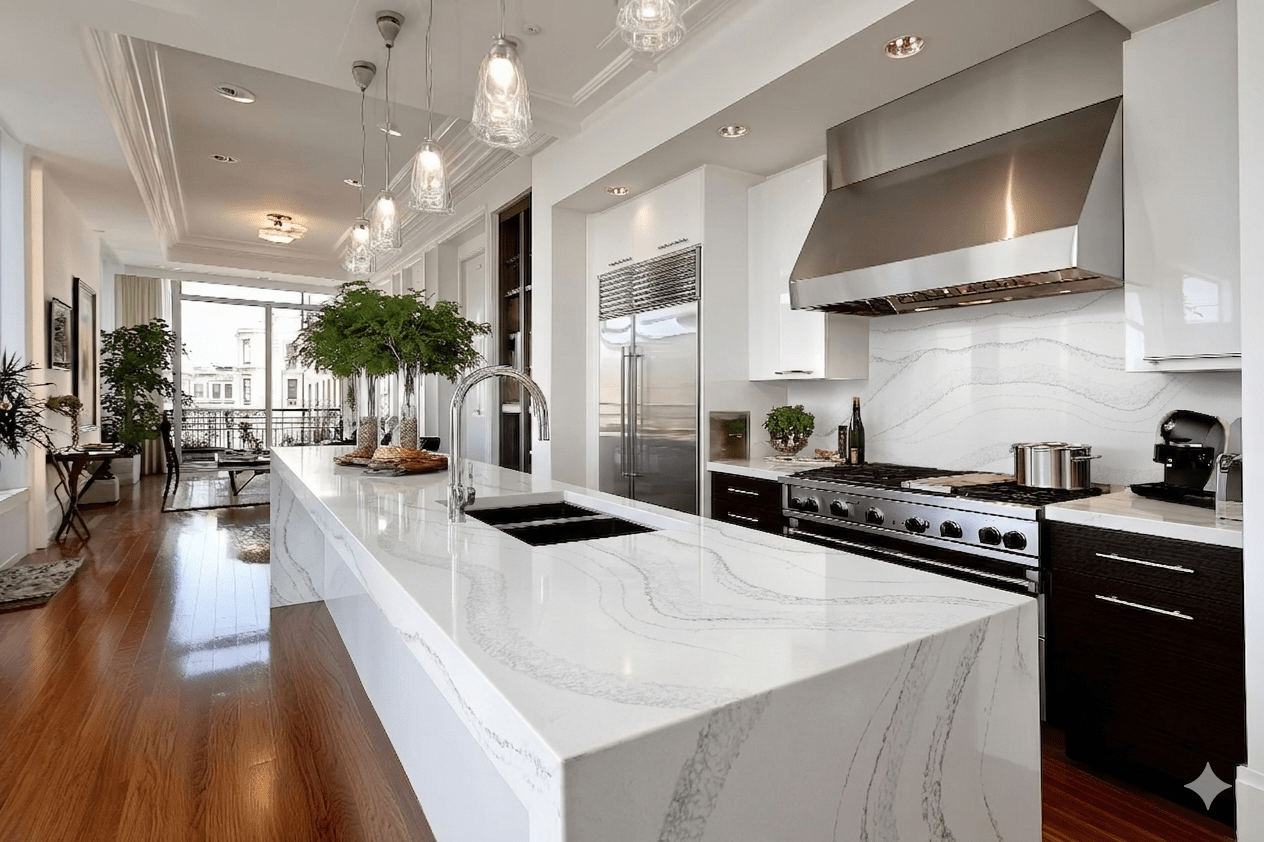
This matters enormously with granite and quartzite.
Natural stone is natural.
Two slabs sold under the same stone name can have different:
If your kitchen requires multiple slabs, don’t approve one slab and assume the next one will look identical.
Whenever possible, look at the slabs together.
For projects with prominent natural veining, slab selection isn’t just choosing a color.
You’re selecting the actual artwork that will become your kitchen.
For dramatic stone installations, customers sometimes want bookmatched veins, where adjoining pieces create a mirrored pattern.
When the right slabs and layout allow it, the result can be spectacular.
But bookmatching may require specific consecutive slabs, additional material and careful fabrication planning.
It can also affect how efficiently the slab can be used.
If bookmatching is important to you, discuss it before the material is ordered and fabricated.
Don’t assume it can simply be added later.
Here’s something most people don’t think about while looking at slabs:
You’re going to cut holes in them.
That beautiful vein running through the center of your slab?
Your sink may remove half of it.
Your cooktop may remove another section.
That’s why slab layout matters.
Sometimes moving a cut slightly—or choosing a different section of the slab—can create a better finished appearance.
This is especially important with expensive natural quartzites and highly directional quartz patterns.
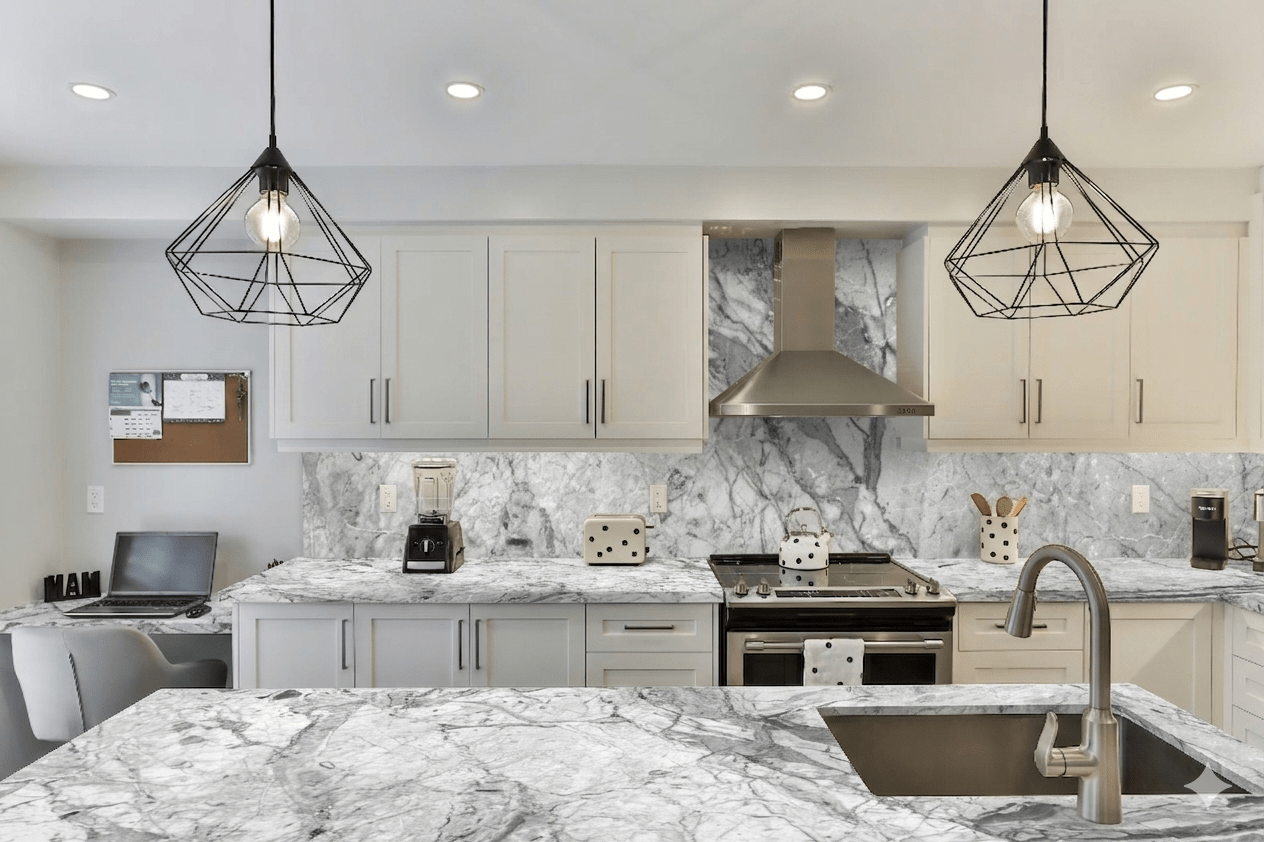
A waterfall island changes everything.
Now the countertop isn’t only horizontal.
The pattern continues vertically down the side of the island.
If you want the veins to appear to flow from the countertop down the waterfall, the pieces need to be planned carefully.
That may require more material.
It may also create compromises elsewhere in the slab layout.
A waterfall isn’t simply:
“Add another piece to the side.”
If appearance matters, it needs to be part of the slab-layout strategy from the beginning.
Once we understand the layout, slab size, seams, veins, cutouts and viewing angles…
Now let’s talk about color.
Of course color matters.
Your countertop should work with your cabinets, flooring, backsplash, appliances, hardware and overall style.
But don’t select it in isolation.
Bring cabinet and flooring samples when possible.
And don’t evaluate a countertop only under showroom lighting.
Warm lighting, cool lighting and natural daylight can make the same surface look surprisingly different.
A warm white countertop may suddenly look yellow next to a cool white cabinet.
A gray vein may appear blue under certain lighting.
Materials interact with everything around them.
This may be more important than any design trend.
Do you cook every day?
Do you have young children?
Does everyone gather around the island?
Do you leave coffee, oil and food on the countertop?
Do you want essentially zero maintenance?
Are you comfortable sealing natural stone?
Do you frequently use hot cookware?
Your answers help determine whether quartz, granite, quartzite or another surface makes sense.
Material first. Design second. Color third.
That’s a very different process from walking into a showroom and asking, “What’s your most popular white?”
We’ve seen beautiful slabs.
We’ve also seen beautiful slabs that weren’t the right slabs for a particular kitchen.
That’s the difference.
When choosing countertops, don’t only ask:
“Do I like this color?”
Ask:
Will it fit my island without a seam?
If I need a seam, where will it go?
What happens to these veins when the countertop turns a corner?
Which direction will the veins run on my island?
What will I see when I walk into the room?
What happens when we cut out the sink and cooktop?
If I need two slabs, do they work together?
How will a waterfall affect the layout?
And finally:
Does this material fit the way my family actually uses the kitchen?
Those questions will tell you far more than the color name printed on the back of a sample.
At Megastone in Elk Grove Village, Illinois, we fabricate and install quartz, quartzite, granite and other countertop materials throughout Chicagoland, Northwest Indiana, Milwaukee and southeastern Wisconsin.
Our goal isn’t simply to help you find a pretty slab.
It’s to think about what happens after that slab gets cut.
Because ultimately, you’re not buying a slab.